Training DeepFilterNet with accurate room acoustic simulations
This page supports our paper presented at IWAENC 2026, Training DeepFilterNet with Accurate Room Acoustic Simulations Improves Single-Channel Speech Enhancement, available also on arXiv.
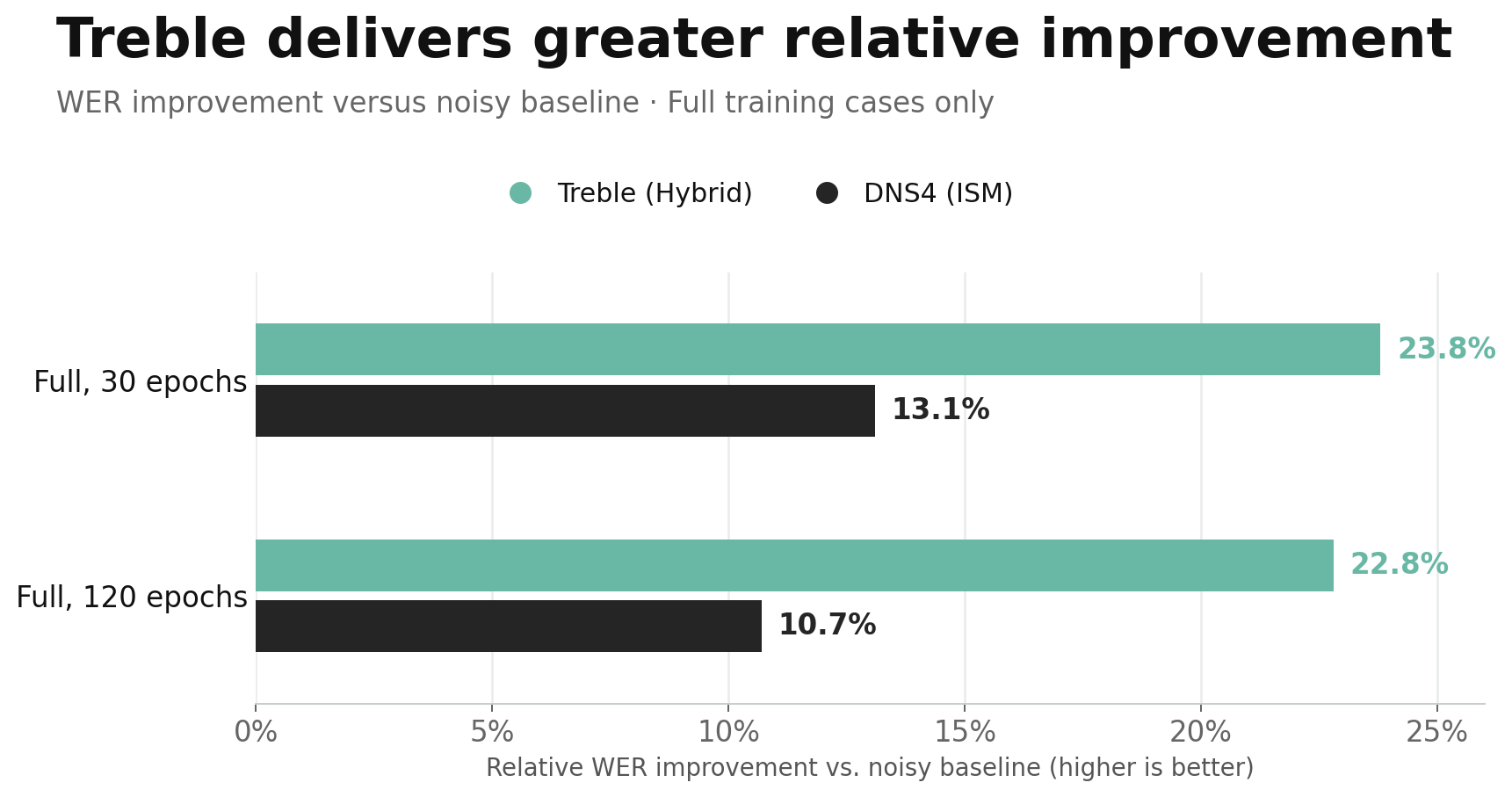
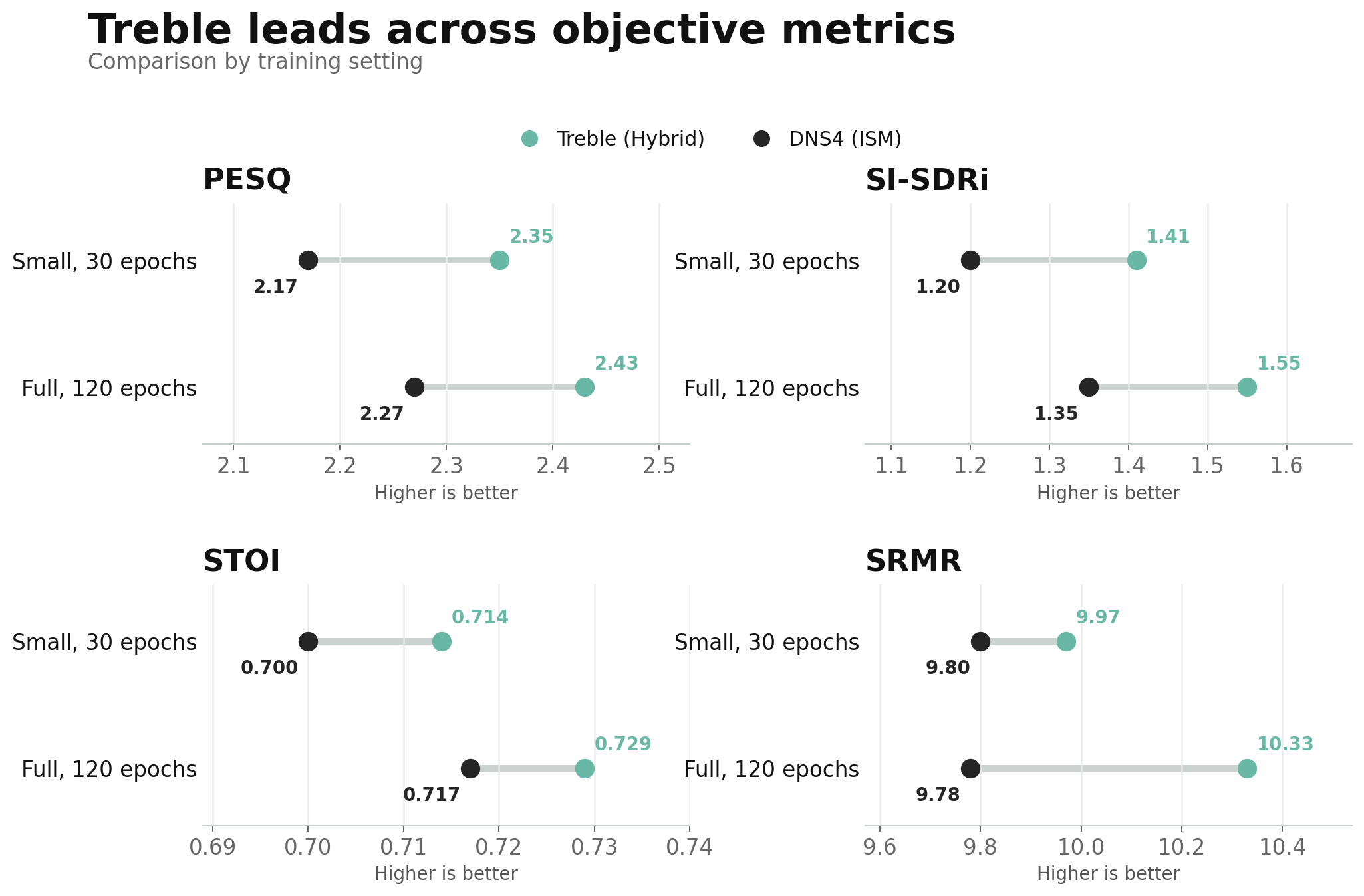
The paper shows that training data generated from physics-accurate room acoustic simulation, rather than simplified reverberation models, measurably improves single-channel speech enhancement performance with DeepFilterNet on objective metrics and downstream ASR.
Reproduce the results
Code to reproduce the paper's results — evaluation and analysis scripts, pre-computed objective and ASR metrics, and the ISM DeepFilterNet checkpoints — is available in the iwaenc2026milo GitHub repository.
The dataset behind the paper
The results were produced using a Treble dataset spanning Small, Medium, and Large room configurations. See Where datasets come from for background on how Treble datasets are built and sourced.
Access to this dataset is arranged directly with our team: get in touch, or start a trial to purchase it.
Working with datasets and IR collections
Below you can find access resources on how to manage audio datasets and IR collections.
Audio datasets
Load, construct, and manage audio datasets for use with scene generation.
IR collections
Organize, filter, process, and render impulse responses and their metadata.
A Treble-native DeepFilterNet
We're working on a version of DeepFilterNet that loads training data directly from Treble. This version offers an integration with our Audio Scene Generator so that the training in DeepFilterNet can load audio scenes with a more accurate scene representation and ir assignment. If you're interested, get in touch.
Audio scene generation
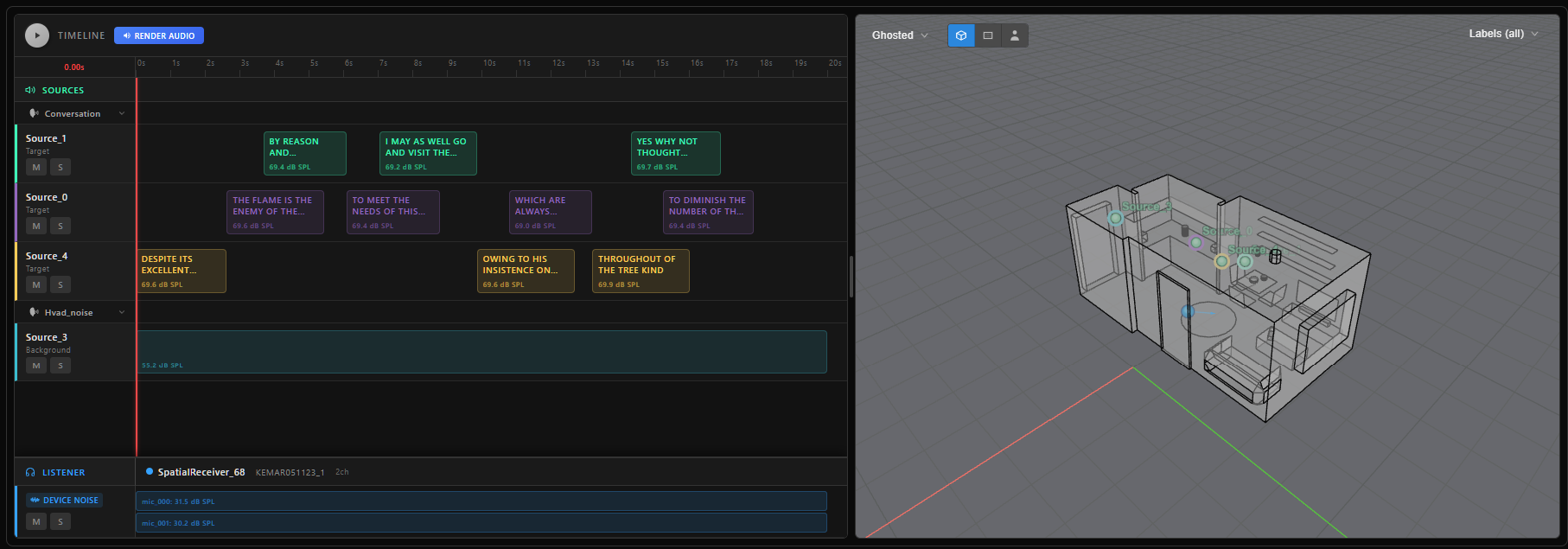
Training and evaluating audio ML models requires more than clean impulse responses — it requires complete acoustic scenes with realistic mixtures of speech, noise, and device artifacts, paired with ground-truth metadata. The Treble SDK audio scene generator produces these scenes by convolving room impulse responses with speech and noise signals, with native support for rule-based conversational turn-taking, configurable signal-to-noise ratios, device noise simulation, and bulk generation. Each output scene ships with structured metadata, ready for ML training and evaluation pipelines.
Take a look at the Audio Scene Generation notebook.
Explore the full set of audio scene tutorials to get started.
Used in the FFASR initiative
The scene generation workflow powers FFASR, a Far-Field ASR leaderboard that benchmarks speech recognition under clean, noisy, and reverberant conditions.
Audio scene generation is particularly useful for building evaluation scenes like these — pairing simulated rooms with realistic conversational and noise mixtures at scale. A notebook walking through this use case will follow.
In the meantime, get in touch or start a trial to try it yourself.
Related pages
- ML training data generation — Generate acoustic training data with the Treble SDK.