ML dataset curation and filtering
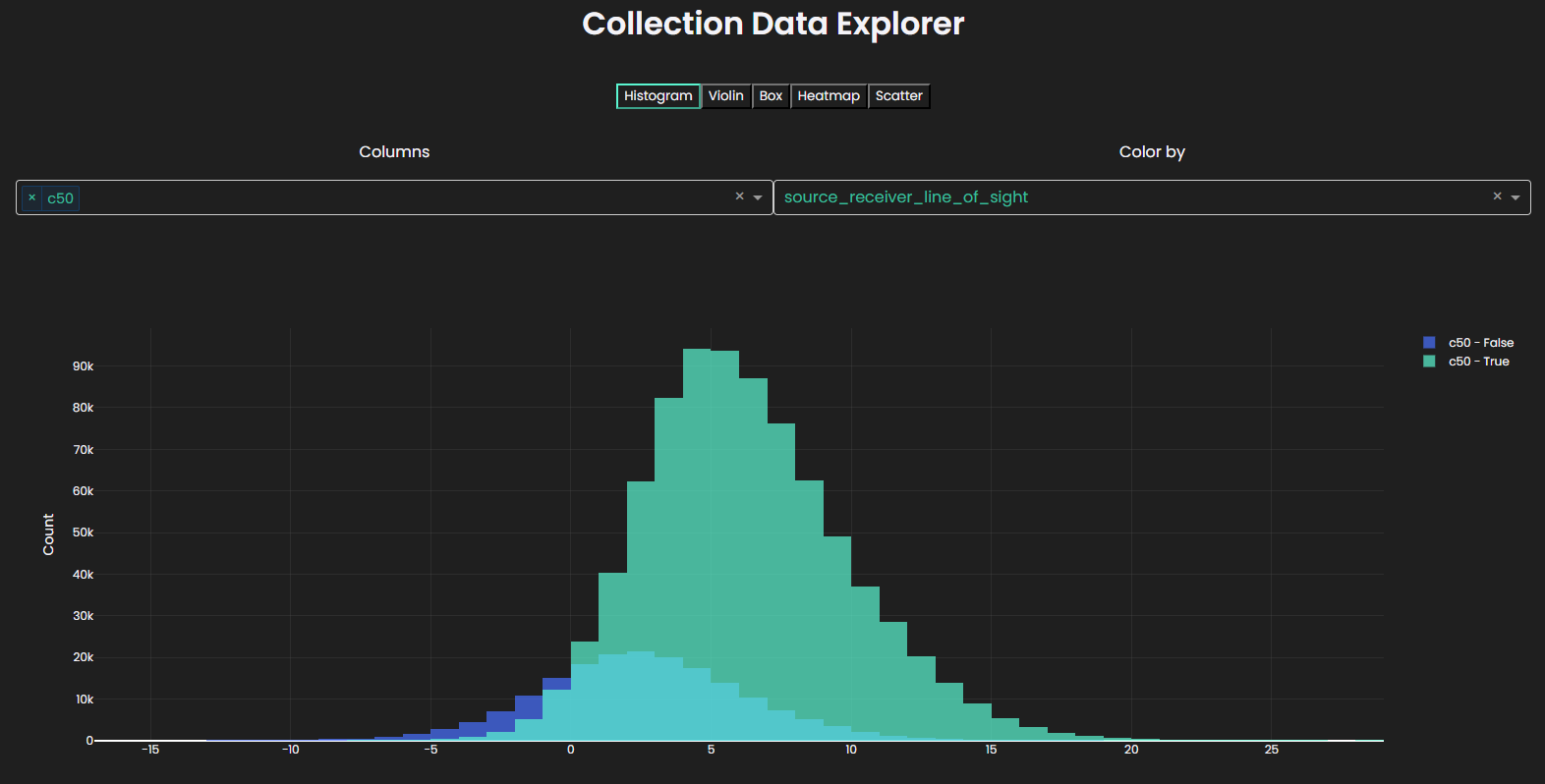
Working with large acoustic datasets requires more than raw audio files. It requires structured metadata that makes the data queryable, filterable, and suitable for constructing controlled training or evaluation splits. Without spatial and acoustic metadata attached to each IR or scene, selecting subsets by room geometry, source-receiver configuration, or acoustic condition becomes impractical at scale.
The Treble SDK supports metadata generation and filtering natively for IR collections and scene collections alike. For each IR in a dataset, you can compute and attach spatial metadata, including the distance of sources and receivers to room boundaries, source-receiver distance, and line-of-sight classification, alongside acoustic parameters such as T20, C50, and EDT. Once attached, this metadata enables precise filtering and the construction of controlled distributions over any parameter of interest, such as a uniform sweep over reverberation time or a Gaussian distribution over source-receiver distance.
The examples below use Treble10, a free curated IR dataset you can load without running any simulations, as a concrete starting point. The same workflow applies to any collection, including one generated with the ML training data generation workflow.
For the full set of IR collection operations, including audio loading, acoustic parameter enrichment, device rendering, and train/test splitting, see IR collections.
IR collection metadata and filtering
The following notebook demonstrates this workflow using the Treble10 dataset, a curated set of room impulse responses freely available to all SDK users. It covers metadata computation, parameter-based filtering, and distribution-controlled sampling. The same operations transfer directly to any IR or device IR collection, including collections generated from your own simulations.
Webinar reference
The following recording from a Treble webinar demonstrates the IR collection metadata and filtering workflow. It uses an earlier version of the SDK and an earlier version of the notebook above, so some API details and examples may differ from the current content.